

7 Ways Your Roof Affects Your Florida Homeowner's Insurance (2026 Guide)

Florida homeowner reviewing insurance policy with roof age requirements and premium factors

Florida homeowner’s insurance has transformed from a background expense to a homeownership crisis over the past five years. Premiums have doubled or tripled. Major carriers have exited the state. Citizens Property Insurance, the state-run insurer of last resort, now covers over 1.3 million policies with premiums that reflect its position as the only option for many homeowners.

Your roof sits at the center of this insurance crisis. Insurance companies evaluate roofs through increasingly strict underwriting criteria that determine whether you can obtain coverage at all, what you’ll pay in premiums, and how claims will be settled. A roof that was insurable three years ago may be uninsurable today. Premium discounts available for certain roof features can save thousands of dollars annually, while the wrong roof configuration can price coverage beyond affordability.

This guide examines the seven specific ways your roof directly impacts your Florida homeowner’s insurance in 2026, explains the mechanisms behind each impact, and provides actionable strategies for optimizing both coverage and cost. Whether you’re facing a non-renewal notice, shopping for new coverage, or planning a roof replacement, understanding how insurance companies evaluate roofs helps you make decisions that protect both your home and your financial position.

1. Roof Age Determines Insurability and Coverage Terms

Insurance companies use roof age as the primary screening criterion for new policies and renewal decisions. This wasn’t always true, ten years ago, roof age appeared on applications but rarely determined coverage availability. In 2026, roof age functions as a hard cutoff that eliminates coverage options entirely.

The 15-20 Year Age Limit Reality

Most Florida insurance companies won’t write new policies on roofs older than 10-15 years without inspection. For renewals, companies typically non-renew at 15-20 years regardless of actual condition.

How age limits work in practice:

  • 0-10 years: Full coverage available, all carriers compete, best rates
  • 10-15 years: New policies require inspection showing “good condition,” some carriers restrict coverage
  • 15-20 years: Most carriers non-renew existing policies, new policies rarely available from private companies
  • 20+ years: Citizens Property Insurance or surplus lines only options, premiums 2-3x higher than standard market

Why insurance companies use age limits:

Age correlates with failure likelihood better than condition assessments. A 17-year-old roof that “looks perfect” externally may have underlayment degradation, fastener corrosion, or shingle adhesive breakdown invisible from ground level. Rather than risk these hidden issues, insurance companies use age as a proxy for condition and exclude older roofs entirely.

Actual Cash Value vs. Replacement Cost Coverage

Even when insurers cover older roofs, coverage terms change dramatically based on age.

Replacement Cost Coverage: Insurance pays full replacement cost with no depreciation. If your $25,000 roof fails, insurance pays $25,000.

Actual Cash Value Coverage: Insurance pays replacement cost minus depreciation. If your 17-year-old roof fails, insurance might pay only $7,500 (30% of value) on a $25,000 replacement.

Florida carriers typically switch from Replacement Cost to Actual Cash Value at:

  • Shingle roofs: 15 years
  • Metal roofs: 25 years
  • Tile roofs: 25 years

This creates a scenario where homeowners pay full premiums but receive only partial payout on covered claims, often insufficient to actually replace the damaged roof.

The Non-Renewal Letter Timeline

Florida insurance non-renewal notice due to roof age showing 15-20 year limits

When your roof reaches the carrier’s age limit, expect a non-renewal notice providing 90-120 days to either replace the roof or find new coverage.

Common scenario:

Year 16 of roof: Notice arrives stating “roof exceeds underwriting guidelines, policy will non-renew in 90 days unless roof is replaced.”

Your options:

  1. Replace roof ($15,000-$40,000 depending on size and materials)
  2. Find new private market insurance (difficult/impossible with 16-year roof)
  3. Apply to Citizens Property Insurance (premiums typically $3,000-$6,000 higher annually)
  4. Go uninsured (illegal if you have a mortgage)

Most homeowners choose roof replacement. Paying $20,000-$25,000 once beats paying $4,000-$5,000 extra annually for inferior Citizens coverage.

The Inspection Alternative (Temporary)

Some carriers allow 10-15 year roofs to remain insurable if professional inspection documents “good condition.” This typically requires:

  • Licensed roofing contractor inspection report
  • Photos documenting no missing/damaged shingles
  • Confirmation of no active leaks or water damage
  • Documentation of remaining useful life (typically 5+ years required)

This extends insurability 1-3 years but rarely past the 18-20 year mark. It’s a temporary reprieve, not a permanent solution.

2. Roof Material Determines Premium Discounts and Coverage Availability

Insurance companies price premiums based on roof material’s expected performance during hurricanes and severe weather. Material choice can swing annual premiums by 15-35%.

Impact-Resistant Shingles: The Insurance Discount Material

Impact-resistant (IR) shingles rated UL 2218 Class 4 qualify for Florida insurance discounts mandated by state law.

Typical discount structure:

  • Class 4 impact-resistant shingles: 10-20% annual premium discount
  • Standard architectural shingles: No discount
  • 3-tab or builder-grade shingles: Often uninsurable or 10-15% premium surcharge

Real premium impact:

Homeowner with $3,500 annual premium:
– Standard shingles: $3,500/year
– Class 4 IR shingles: $2,975/year (15% discount)
– Annual savings: $525
– 25-year savings: $13,125

Class 4 IR shingles cost $3,000-$6,000 more than standard shingles on typical Florida home. The insurance discount recovers this cost in 6-12 years, then provides pure savings for the remaining roof life.

Class 4 shingle options in Florida:

  • Atlas Signature Select IR
  • CertainTeed Impact Resistant
  • GAF Timberline HDZ RS
  • Owens Corning SureNail IR

All provide equivalent insurance benefits. Choose based on warranty, aesthetics, and contractor certification capabilities.

Metal Roofing: Maximum Premium Discounts

Metal roofing qualifies for the highest insurance premium discounts available in Florida.

Metal roof insurance benefits:

  • Class A fire rating: 5-10% discount
  • Impact resistance: 10-15% discount (when rated Class 4)
  • Wind resistance: 10-20% discount (metal withstands 180+ mph winds)
  • Combined discounts: 25-35% annual premium reduction possible

Metal roofs also maintain insurability longer, many carriers don’t apply age limits until 30-40 years for metal roofs, compared to 15-20 years for shingles.

Premium example with metal roof:

$4,000 annual premium with shingles:
Metal roof with combined discounts: $2,800/year (30% reduction)
Annual savings: $1,200
20-year savings: $24,000

Metal roofs cost $18,000-$45,000 more than shingles upfront but the insurance savings combined with 50+ year lifespan often produces superior lifetime value.

Tile Roofing: Durability Meets Insurance Requirements

Concrete and clay tile roofs qualify for moderate insurance discounts and extended insurability.

Tile roof insurance benefits:

  • Class A fire rating: 5-10% discount
  • Impact resistance: 5-15% discount (varies by tile type)
  • Wind resistance: 10-15% discount when properly installed
  • Extended age limits: Carriers often insure tile roofs to 30+ years

Tile’s main insurance advantage is longevity, a tile roof installed at 35 remains insurable when shingle roofs require replacement. This avoids the insurance-forced replacement cycle entirely for 40-50 years.

Materials That Hurt Insurance Availability

Some roof materials create insurance problems in Florida:

Flat/low-slope modified bitumen or built-up roofs: Many carriers restrict or decline coverage. Higher leak risk and difficult inspection access make these undesirable for insurers.

Wood shake shingles: Most Florida carriers won’t insure wood roofs due to fire risk and hurricane performance. Available coverage comes with 25-40% premium surcharge.

3-tab shingles: Increasingly uninsurable in Florida coastal areas. When coverage exists, expect 10-15% premium penalty compared to architectural shingles.

3. Wind Mitigation Features Create Substantial Premium Discounts

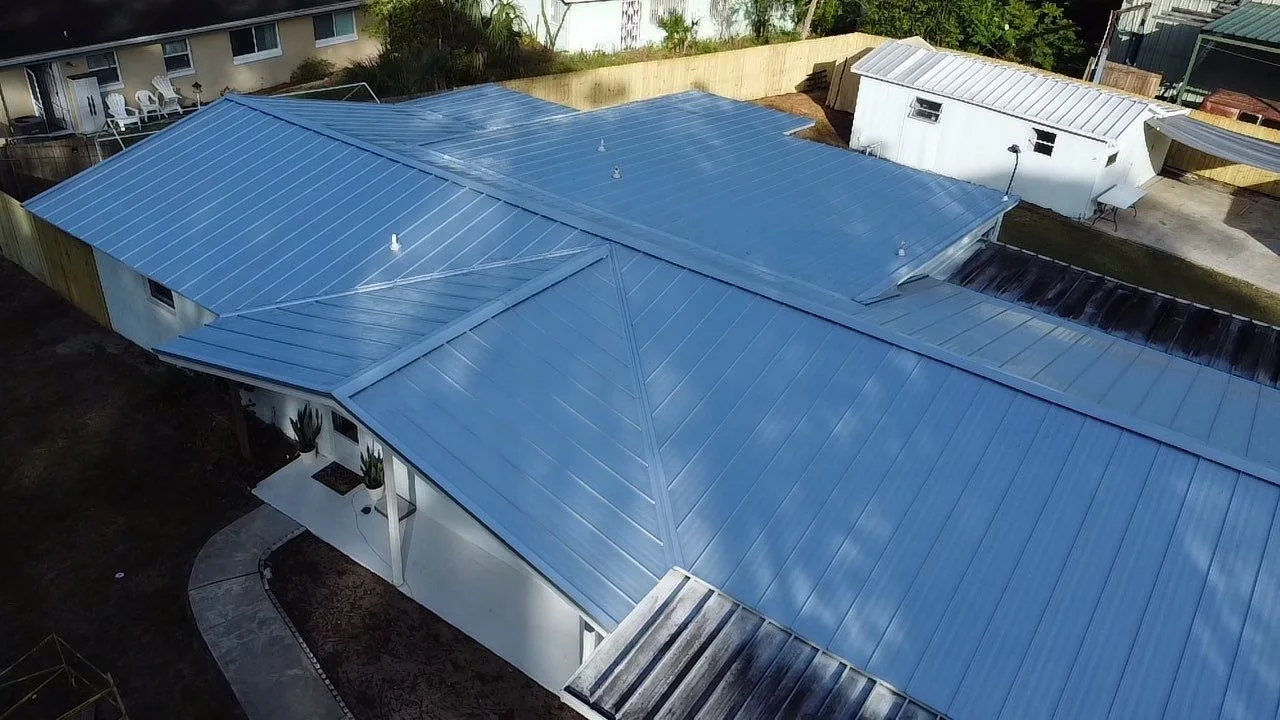
Florida wind mitigation roof for insurance discount

Florida law requires insurance companies to provide premium discounts for documented wind mitigation features. These discounts stack with material-based discounts, creating potential savings of 35-50% on annual premiums.

Understanding the Wind Mitigation Inspection

A Florida-licensed wind mitigation inspector documents your home’s wind-resistant features on the state-mandated OIR-B1-1802 form. This form evaluates:

  • Building code compliance year
  • Roof covering type
  • Roof deck attachment
  • Roof-to-wall attachment
  • Roof geometry
  • Opening protection (windows/doors)

Each feature provides specific discounts mandated by Florida law.

Roof-Specific Wind Mitigation Credits

Roof Covering (5-20% discount):

Sealed roof deck with secondary water resistance qualifies for maximum credit. This typically means:

  • Self-adhering underlayment (peel-and-stick) throughout, OR
  • Sealed plywood deck with integrated water barrier

Standard felt underlayment with shingles qualifies for minimal or no credit. Upgrading to self-adhering underlayment during roof replacement can add $2,000-$4,000 to project cost but provides 10-15% annual insurance savings.

Roof Deck Attachment (5-25% discount):

How roof decking attaches to trusses/rafters significantly affects wind uplift resistance:

  • Best: 8d nails at 6″ spacing (maximum 25% discount)
  • Good: 8d nails at 12″ spacing (15-20% discount)
  • Standard: Staples or 8d nails at standard spacing (5-10% discount)

Roof deck attachment is determined during construction and can’t be changed without removing entire roof. This factor alone can create permanent $500-$1,000 annual premium differences between similar homes.

Roof-to-Wall Attachment (5-30% discount):

How roof connects to walls determines whether roof stays attached during hurricanes:

  • Hurricane straps/clips: 20-30% discount
  • Toe nails (standard construction): 5-10% discount

Adding hurricane clips during re-roofing isn’t practical on existing homes, but this illustrates why newer construction (post-2002 Florida Building Code) receives better insurance rates.

Roof Geometry (5-25% discount):

Hip roofs (all slopes meet at ridges, no vertical walls) outperform gable roofs (triangular end walls) in wind resistance:

  • Hip roof: 15-25% discount
  • Gable roof: 5-10% discount

Roof geometry can’t change without major structural renovation, but understanding its impact helps explain premium differences between homes.

Combined Wind Mitigation Savings Example

Florida home with $4,500 annual premium, gable roof with standard construction:

After re-roofing with wind mitigation upgrades:

  • Sealed roof deck (peel-and-stick underlayment): 15% discount = $675 saved
  • Impact-resistant shingles: 15% discount = $675 saved (applied to reduced premium)
  • Hurricane shutters added: 10% discount = additional savings

New annual premium: ~$3,200
Annual savings: $1,300
20-year savings: $26,000

Wind mitigation inspection costs $75-$150. The documented features save thousands annually, making this one of the highest-return home improvement investments possible in Florida.

4. Roof Condition Determines New Policy Eligibility

Even on roofs within acceptable age ranges, visible condition determines whether insurance companies write new policies or renew existing coverage.

What Insurance Inspectors Look For

When you apply for Florida homeowner’s insurance, most companies now require third-party roof inspection. Inspectors evaluate:

Missing or damaged shingles: Even 3-5 missing shingles can trigger policy denial. Insurance companies interpret this as deferred maintenance or wind damage that indicates future claims likelihood.

Granule loss: Exposed asphalt backing through worn shingles signals approaching end-of-life. Advanced granule loss on roofs under 15 years raises questions about installation quality or manufacturing defects.

Curling or cupping: Shingle edges lifting or forming concave shapes indicate age-related deterioration or inadequate ventilation. This creates leak risk and wind uplift vulnerability.

Algae or moss growth: Black streaking (algae) is cosmetic but widespread moss growth indicates moisture retention problems. Some carriers deny coverage based on excessive moss.

Valley condition: Roof valleys concentrate water flow. Deteriorated valleys signal likely leak sources. Many inspectors photograph valleys specifically.

Flashing integrity: Gaps, rust, or separation around chimneys, vents, and wall intersections create leak pathways. Insurance companies view flashing problems as maintenance neglect.

Soft spots or sagging: Visible from ground level, these indicate structural issues beyond normal wear. Automatic policy denial in most cases.

The “Good Condition” Standard

Insurance companies don’t define “good condition” consistently, but practically it means:

  • No visible damage from ground-level inspection
  • No missing shingles or exposed underlayment
  • Minimal granule loss (shingles still show original color clearly)
  • No curling, cupping, or lifting
  • Clean appearance (minor algae acceptable, heavy moss is not)
  • Intact flashing around all penetrations
  • No visible sagging or structural concerns

Roofs failing any of these criteria typically receive “poor condition” rating that results in policy denial or non-renewal.

The Pre-Listing Repair Requirement

Some insurance companies now require documented repairs before policy issuance. Common scenario:

  1. Apply for insurance on home you’re buying
  2. Carrier orders inspection
  3. Inspector notes “12 missing shingles on south slope”
  4. Carrier issues conditional approval: “Policy will issue after missing shingles are repaired and re-inspection confirms”
  5. You pay for repairs ($300-$800) and re-inspection ($75-$150)
  6. Policy issues after documented completion

This adds cost and timeline complexity to home purchases, but refusing to repair means no insurance and no closing.

Proactive Maintenance Protects Insurability

Simple maintenance preserves insurance eligibility:

Annual inspection: Licensed contractor inspection ($0-$150) identifies problems before insurance inspectors do. Fix 3-5 missing shingles for $200-$400 rather than lose coverage.

Gutter cleaning: Clogged gutters overflow onto fascia and roof edges, creating visible water damage that insurance inspectors flag.

Algae treatment: While cosmetic, heavy algae growth suggests neglect. Professional algae removal ($200-$500) restores clean appearance.

Trim overhanging trees: Branches touching roof create abrasion damage and moisture problems. Trimming prevents both damage and negative inspection findings.

Spending $500-$1,000 annually on preventive maintenance costs less than losing insurance or facing forced repair requirements.

5. Roof Claims History Affects Future Premiums and Renewals

Filing roof damage claims creates permanent record in CLUE (Comprehensive Loss Underwriting Exchange) database that follows you for 5-7 years and affects all future insurance applications.

How Claims Affect Premiums

First claim: Typically 15-25% premium increase at next renewal. Some carriers non-renew after single large claim ($20,000+).

Second claim within 3 years: 30-50% premium increase or non-renewal. Most carriers non-renew after two roof claims in 3-5 years.

Third claim within 5 years: Nearly impossible to obtain standard market coverage. Citizens Property Insurance or surplus lines market only options.

Example premium progression:

Base premium: $2,500/year
After first claim: $3,000/year (20% increase)
After second claim: $4,500/year (50% increase from new base)
After third claim: Non-renewed, Citizens charges $6,500/year

Three claims over five years transforms $2,500 annual cost into $6,500 annual cost, an increase of $4,000/year or $20,000 over the next five years.

The Strategic Claims Decision

Not all roof damage should generate insurance claims. Consider:

Claim if:

  • Damage exceeds $10,000 and your deductible by significant margin
  • Entire roof requires replacement due to widespread damage
  • Structural damage affects decking or trusses
  • Active leaks create interior damage beyond roof itself

Consider paying out-of-pocket if:

  • Repair cost is close to or below deductible
  • Limited damage affects small roof section only
  • You’ve filed claims recently (second claim risk)
  • Damage is borderline wear-and-tear vs. covered peril

Decision framework example:

$4,500 roof repair needed, $2,500 deductible:

  • Insurance pays: $2,000
  • Your premium increases: +$500/year for next 3-5 years = $1,500-$2,500 total increase
  • Net benefit of claim: $2,000 payout – $2,000 premium increases = $0 or negative

Paying the $4,500 repair yourself costs more immediately but preserves claims-free discount and avoids premium increases.

Claims History Follows the Property

CLUE reports attach to both homeowner and property address. When selling your home:

Buyers’ insurance companies see your property’s claim history. Three roof claims in five years makes the property difficult to insure for buyer, potentially killing sales or reducing offers.

This creates another reason to minimize claims, protecting future resale value.

The Claims-Free Discount

Most Florida carriers provide 5-15% premium discount for 3-5 years claims-free. This discount disappears immediately upon filing any claim, even small ones.

Homeowner with $3,000 premium and 10% claims-free discount:

  • Current premium: $2,700 (with discount)
  • After filing $3,000 claim: Premium becomes $3,450 (discount removed + 15% increase)
  • Annual cost increase: $750
  • Three-year cost increase: $2,250

The $3,000 claim (after $2,500 deductible = $500 payout) costs $500 in immediate benefit but triggers $2,250 in premium increases. Filing the claim costs $1,750 net over three years.

Florida insurance claim documentation showing roof damage assessment and CLUE report impact

6. Proper Documentation and Maintenance Records Matter

Insurance companies increasingly require proof of proper roof maintenance and documented installation quality to issue or renew policies.

What Documentation Insurance Companies Request

Installation receipt and warranty: Proof of professional installation with contractor license number. DIY or unlicensed contractor installations create coverage problems.

Building permit: Permitted work demonstrates code compliance. Unpermitted roof replacements can void insurance coverage entirely.

Manufacturer certification: Enhanced warranties from certified contractor installations demonstrate quality and extend roof insurability.

Wind mitigation inspection: Official OIR-B1-1802 form documenting wind-resistant features. Required for claiming premium discounts.

Maintenance records: Some carriers request proof of annual inspections or maintenance, particularly on roofs approaching 10+ years.

The Permit Problem

Unpermitted roof work creates insurance nightmares:

During claims: Insurance adjuster discovers unpermitted work during damage inspection. Carrier denies entire claim based on unpermitted modifications.

During underwriting: New carrier discovers unpermitted roof during inspection. Policy application denied.

During renewal: Existing carrier discovers unpermitted work through updated inspection. Policy non-renewed.

Saving $400-$600 on permits creates $15,000-$30,000 of risk through voided insurance coverage.

The Professional Installation Requirement

Most Florida carriers now explicitly exclude coverage for roofs installed by:

  • Homeowner (DIY installation)
  • Unlicensed contractors
  • Out-of-state contractors without Florida licensing
  • Handymen without proper roofing credentials

Even if work quality is acceptable, lack of proper licensing creates coverage denial.

What insurance companies want to see:

  • Florida CCC (Certified Roofing Contractor) or CGC (Certified General Contractor) license
  • Proof of contractor’s liability insurance
  • Building permit pulled by licensed contractor
  • Final inspection approval
  • Written warranty from contractor

This documentation proves professional installation that meets code standards insurance companies rely on.

Manufacturer Certification Extends Insurability

Roofs installed by manufacturer-certified contractors remain insurable longer and qualify for better coverage terms:

Benefits of certified installation:

  • Enhanced 25-50 year warranties demonstrate quality
  • Some carriers extend age limits for certified installations
  • Documentation provides clear installation date and materials used
  • Certification indicates proper installation reducing claim likelihood

At Pinnacle Roofing Group, our Atlas PRO+ Diamond Select certification (top 1% of installers) and CertainTeed Select ShingleMaster status provide documentation that insurance companies value and homeowners benefit from through extended insurability periods.

7. Proactive Roof Replacement Timing Optimizes Insurance Outcomes

When you replace your roof affects insurance more than homeowners realize. Strategic timing creates savings opportunities and avoids coverage gaps.

Replace Before Non-Renewal

Reactive replacement after non-renewal notice creates problems:

Timeline pressure: 90-120 days to complete replacement often falls during hurricane season when contractors are booked or unable to work due to weather.

Limited insurance options: New carriers see your previous non-renewal and interpret as risk signal. This limits options and increases premiums.

Coverage gap risk: If roof replacement isn’t complete before non-renewal effective date, you lose coverage entirely.

Better approach, proactive replacement:

Replace roof at 12-14 years (before non-renewal notices start). This provides:

  • Contractor selection flexibility (not desperate, can get multiple quotes)
  • Seasonal timing choice (avoid hurricane season, get better pricing in slow seasons)
  • Continuous coverage (no gaps or lapses)
  • Better rates from current carrier (renewal with new roof vs. shopping with old roof)

The Premium Reset Opportunity

New roof installation creates rate shopping opportunity:

Scenario 1 – React after non-renewal:

  1. Current carrier non-renews due to 17-year roof
  2. Replace roof under pressure
  3. Shop for new insurance with history of non-renewal
  4. Limited carrier options, higher rates despite new roof

Scenario 2 – Proactive replacement:

  1. Replace roof at year 13 while policy is good standing
  2. Submit updated information to current carrier (premium reduction)
  3. Shop multiple carriers with new roof, no non-renewal history
  4. Multiple competitive quotes, 20-30% premium savings available

Proactive replacement at year 13 costs the same as reactive replacement at year 17, but creates $3,000-$6,000 of insurance savings over next 10 years through better rates and more carrier options.

Coordinating Replacement with Impact-Resistant Upgrade

Optimal strategy: Replace roof before age-out with impact-resistant shingles qualifying for immediate insurance discounts.

Financial analysis:

Cost to upgrade to Class 4 IR shingles: +$4,500
Insurance discount: 15% on $3,500 premium = $525/year
Payback period: 8.6 years
Remaining roof life after payback: 16-20 years of pure savings
Total lifetime savings: $8,400-$10,500

The upgrade pays for itself and then provides net benefit for majority of roof’s lifespan.

Wind Mitigation Inspection Timing

Schedule wind mitigation inspection immediately after roof replacement completion, before insurance renewal:

  1. Roof replacement completes
  2. Wind mitigation inspector documents features (cost: $75-$150)
  3. Submit OIR-B1-1802 form to insurance company
  4. Discounts apply at next policy renewal (or immediately if negotiated)

Waiting months to get inspection delays discount application and costs money in missed savings.

Frequently Asked Questions About Roofs and Florida Insurance

How does roof age affect homeowner's insurance in Florida?

Roof age directly determines insurance availability and premium costs in Florida. Most carriers won’t write new policies on roofs over 10-15 years without inspection, and non-renew existing policies at 15-20 years regardless of condition. Roofs 15+ years old typically only qualify for Actual Cash Value coverage (depreciated payouts) rather than Replacement Cost coverage. After age 20, only Citizens Property Insurance or surplus lines carriers provide coverage at 2-3x standard premiums. Insurance companies use age as proxy for failure risk since hidden deterioration (underlayment degradation, fastener corrosion) isn’t visible in condition assessments.

Yes, UL 2218 Class 4 impact-resistant shingles qualify for insurance premium discounts mandated by Florida law. Typical discounts range 10-20% annually. On a $3,500 annual premium, 15% discount saves $525/year or $13,125 over 25-year roof life. Class 4 IR shingles cost $3,000-$6,000 more than standard shingles on average Florida home, creating 6-12 year payback period followed by pure savings. All major manufacturers (Atlas, CertainTeed, GAF, Owens Corning) offer Class 4 options providing equivalent insurance benefits. The discount applies immediately after installation and remains for the roof’s lifetime.

Wind mitigation is a Florida-licensed inspection that documents your home’s hurricane-resistant features on the state-mandated OIR-B1-1802 form. Roof-specific features evaluated include roof covering type, roof deck attachment, roof-to-wall attachment, and roof geometry. Each qualifies for insurance premium discounts: sealed roof deck (10-20% discount), proper deck attachment (5-25%), hurricane clips (20-30%), and hip roof design (15-25%). Combined discounts can reduce premiums 35-50%. Inspection costs $75-$150 and creates permanent savings. Features are determined during construction/re-roofing and generally can’t be changed afterward, making wind mitigation documentation during roof replacement critical for maximizing insurance savings.

Standard market insurance on 20-year-old Florida roofs is extremely difficult and often impossible. Most private carriers have hard cutoffs at 15-20 years. Citizens Property Insurance (state-run insurer of last resort) accepts older roofs but charges premiums 2-3x higher than standard market, often $5,000-$8,000 annually vs. $2,500-$3,000 for newer roofs. Some surplus lines carriers insure 20+ year roofs at premium rates with exclusions. Practical reality: replacing roof before the 15-18 year mark preserves insurance access and avoids the Citizens premium trap. The $20,000-$25,000 roof replacement costs less than 5-7 years of excess Citizens premiums.

Multiple roof claims create severe insurance consequences. First claim typically causes 15-25% premium increase. Second claim within 3 years results in 30-50% increase or non-renewal. Third claim within 5 years makes standard market coverage nearly impossible, only Citizens or surplus lines available at extreme premiums. Claims history follows both homeowner and property address in CLUE database for 5-7 years, affecting all future insurance applications. Strategic approach: file claims only for damage exceeding $10,000 and significantly above deductible. Consider paying for repairs under $5,000-$7,000 out-of-pocket to preserve claims-free discount and avoid premium increases that often exceed claim payout value over 3-5 years.

Yes, when Florida insurance companies issue non-renewal notices due to roof age or condition, replacement is typically the only option to maintain coverage. Timeline is usually 90-120 days. Alternatives to replacement are: (1) Find new carrier willing to insure old roof (extremely difficult/impossible), (2) Switch to Citizens Property Insurance at 2-3x premium increase, or (3) Go uninsured (illegal with mortgage). Most homeowners choose replacement because Citizens premium increases of $3,000-$5,000 annually equal the roof replacement cost within 5-7 years. Proactive replacement at 12-14 years before non-renewal notices avoids timeline pressure and preserves better insurance options.

Florida insurance companies increasingly require: (1) Installation receipt showing contractor license number and date, (2) Building permit proving code-compliant installation, (3) Manufacturer warranty documentation, (4) Wind mitigation inspection form (OIR-B1-1802) for claiming premium discounts, (5) Proof of licensed contractor installation, DIY or unlicensed work can void coverage entirely. Unpermitted roof work discovered during claims or underwriting often results in claim denial or policy cancellation. Professional installation by Florida-licensed contractor (CCC or CGC) with proper permitting creates documentation insurance companies require. Enhanced warranties from manufacturer-certified contractors demonstrate quality and extend insurability periods.

Insurance savings from new roof replacement with proper features can be substantial. Impact-resistant Class 4 shingles: 10-20% annual savings. Wind mitigation features (sealed deck, proper attachment): additional 15-35% savings. Combined discounts: 25-50% total premium reduction possible. Example: $4,000 annual premium becomes $2,400-$3,000 with new roof and all credits ($1,000-$1,600 annual savings = $20,000-$32,000 over 20 years). Beyond discounts, new roof resets age clock allowing 15-20 more years before next insurance-forced replacement. Strategic timing with impact-resistant upgrade and wind mitigation documentation maximizes lifetime insurance savings while ensuring continuous coverage availability.

Insurance optimized roof replacement in Florida by Pinnacle Roofing

Making Strategic Roof Decisions for Insurance Optimization

Florida homeowner’s insurance has evolved from background expense to major financial factor in homeownership decisions. Your roof directly determines insurance availability, premium costs, claims outcomes, and future coverage options through seven specific mechanisms.

The seven ways your roof affects insurance work together:

  • Age determines whether coverage exists at all and what terms apply
  • Material choice creates 10-35% premium swings through mandated discounts
  • Wind mitigation features stack additional 15-35% savings
  • Condition determines new policy eligibility and renewal approval
  • Claims history affects premiums for 5-7 years and follows property address
  • Documentation proves professional installation that insurance requires
  • Replacement timing determines insurance options and long-term costs

Strategic approach: Replace roof proactively at 12-14 years before non-renewal pressure, incorporate impact-resistant materials and wind mitigation features during replacement, document everything for insurance and wind mitigation inspections, and minimize claims by handling minor repairs out-of-pocket.

This approach costs no more than reactive replacement forced by insurance non-renewal but creates $10,000-$30,000 of savings over roof lifetime through better premiums, preserved coverage access, avoided Citizens Property Insurance premiums, and maximized wind mitigation credits.

Your roof represents your home’s primary defense against Florida weather and your insurance company’s primary underwriting concern. Optimizing both protection and insurance outcomes requires understanding how carriers evaluate roofs and making strategic decisions that serve both functions.

Need guidance on insurance-optimized roof replacement?
Pinnacle Roofing Group specializes in coordinating roof replacement with insurance requirements. Call (386) 631-5566 or visit pinnacleroofinggroup.com for free inspection and insurance-optimization consultation. We serve all of Central Florida with Atlas PRO+ Diamond Select certified installations that satisfy carrier requirements and maximize available premium discounts.

Unlocking The Truth Behind Your Estimate

Inside The Pinnacle Process

Saftey At Your Home